

Menu
Services
Quick Links
Site Policies

RDM Optimization - Data structure
Do you need help with your folder structure? Do any of the following sound familiar to you: “where did I put it?”, “Oh, no, did someone delete it!”, or “Where is the backup”?
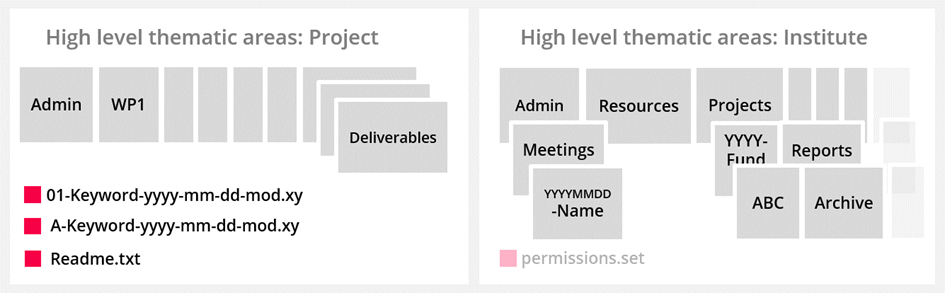
There are some simple rules that make a researcher’s life easier when it comes to organising simple tool-less data folders, such as the 7-folder system by GA. Miller, like the 3 layer sub-folder principle. Following naming conventions, the most relevant topics should be included in the first (top-most) layer, with a recurring structure in the sub-folders. Numbering allows to sort according to importance instead of a simple alphabetical order. Dates should be included systematically using YYYY-MM-TT. There are also some no-gos, such as saving files on your desktop, naming folders indistinctly as “miscellaneous”, or duplicates which are not meant as back-up.
You can start an optimization process by asking your group several questions:
- Is restructuring (including file migration) preferred over creating a new structure?
- Are there any local file systems which have to be integrated? Is digitalization of documents necessary?
- Are there files that can be archived and do not need to be accessed regularly?
After these questions have been answered, you can plan further steps, as e.g. the back-up of the old files and structure, set migration deadlines, or assigning and reminding of tasks to specific persons. After the process, those responsible have to be kept assigned to the tasks to keep a clean structure.
If you are interested in learning some more details, you can find online resources at:
Knowledge clip: Keeping research data organized by Ugent Data Stewardsor a disciplinary In-depth Exercise at:
Carpentries-incubator.github.ioWe can also support you and your group in optimizing an your structure for a suitable collaborative as well as individual management, also allowing newcomers not to get lost, including on- and off-boarding.